Famous Art Pictures Famous Art Pictures That Looks Like Imagenation
The Romanticism movement was a force that dominated Europe during the late 1800s. It was an creative, intellectual, and literary motion cultivated as a reaction to the Classicism and Neoclassicism movements that preceded information technology. A distinct break from the trends of intellectual idea, industrialization, rationalization, and glorification of scientific discipline. The Romanticism motion was emotionally charged and sought to entertain the imagination, nosotros see that in the fantastical and inspired paintings that emerged from this menstruum. In this article, we will explore the 12 most famous Romanticism paintings.
Table of Contents
- 1 Romanticism: A Brief Overview
- 2 12 Most Famous Romanticism Paintings
- 2.1 The Nightmare (1781) by Henry Fuseli
- 2.two Upper Fall of the Reichenbach: Rainbow (1810) by J. M. Westward. Turner
- 2.3 3rd of May 1808 (1814) by Francisco Goya
- 2.4 Wanderer higher up the Sea of Fog (c. 1818) by Caspar David Friedrich
- 2.5 The Raft of the Medusa (1818 – 1819) by Théodore Géricault
- 2.6 The Hay Wain (1821) by John Constable
- 2.7 Épisode des Journées de Septembre 1830 (1830) past Marie-Adélaïde Kindt
- 2.viii Freedom Leading the People (1830) by Eugène Delacroix
- 2.9 The Titan's Goblet (1833) by Thomas Cole
- two.10 The Ninth Wave (1850) by Ivan Aivazovsky
- 2.xi The Buss (1859) by Francesco Hayez
- two.12 Kaaterskill Creek (c. 1870) past Susie One thousand. Barstow
- 3 Frequently Asked Questions
- 3.1 What Is Romanticism?
- 3.ii What Are the Characteristics of Romanticism Art?
- 3.iii How Is Romanticism Shown in Fine art?
Romanticism: A Brief Overview
Romanticism indulged the artist's emotions and imagination, allowing these feelings and ideas to permeate the viewer. Romanticism was interpreted differently by various Romantics regarding their music, literature, and visual fine art. Artists portrayed scenes of love, dazzler, suspense, horror, anger, and adoration that were aimed to provide an escape from reality.
The Romantic period spanned from around 1790 to 1880 and arose from dissatisfaction with the Enlightenment's values of social club and reason after the French Revolution in 1789. Although Romanticism has been detailed as the antonym of the Classicism and Neoclassicism movements, stylistically there were overlaps amongst them.
However, Romanticism did take several distinctions from its preceding movements, as it was characterized by its emphasis on sentiment and passion as opposed to prior conventions of rationality and detachment.
In the visual arts, Romantics paid homage to the power of nature, honoring its unpredictability and beauty. Nature'southward potential for disaster was a prominent theme, along with the portrayal of commanding, poignant feelings that induced empathy. Romantics glorified emotion and intuition over logic and intellect. Romanticism art was attuned to beautiful scenes of nature and the sublime, incorporating the mode humans experience in nature.
Danger and beauty divers nature'south sublime aesthetic.
In opposition to Rationalism, Romantic painters dressed their artworks with brilliant colors and energetic brushstrokes. Romanticism art favored dynamic compositions over static ones. Romantic-era paintings were used to express individuality and instinct instead of depicting idealized representations of the Classical past.
12 Virtually Famous Romanticism Paintings
Romanticism artwork offered a fantastical escape from the reality of urban life. Romanticism focused on feelings and the condition of the soul, which was ofttimes reflected in nature. Romantic period artists did not simply paint what they saw in a mural but painted the way they felt from the landscape. Artists were gratuitous to be creative, harnessing inspiration from their dreams and their consciousness to illustrate fantastic figures or troubled landscapes. Here is our selection of the 12 nearly famous Romanticism paintings.
The Nightmare (1781) past Henry Fuseli
| Artist | Henry Fuseli |
| Engagement Painted | 1781 |
| Medium | Oil on canvas |
| Dimensions | 101.6 cm x 127 cm |
| Where It Is Currently Housed | Detroit Found of Art, Michigan, the United states of America |
Henry Fuseli's Romantic artwork, The Nightmare, was the first of its kind making Fuseli somewhat of a transitional figure– leading the progression of art from The Historic period of Reason to Romantic-era art. Fuseli's peculiar and macabre artwork depicts a seemingly spellbound woman in deep sleep draped across a divan.
The woman has her artillery stretched below her, with a demon-like incubus crouched on top of her, glaring threateningly at the viewer. Partially hidden, we see a mysterious mare with bewitching white eyes and flaring nostrils. In Fuseli'south ghastly portrayal, he paints the woman in an idealized manner, which coincides with the principles of Neoclassicism.
However, he deviated from this past using his painting to explore the darker depths of the human psyche, while most were busied with the scientific exploration of the physical globe.
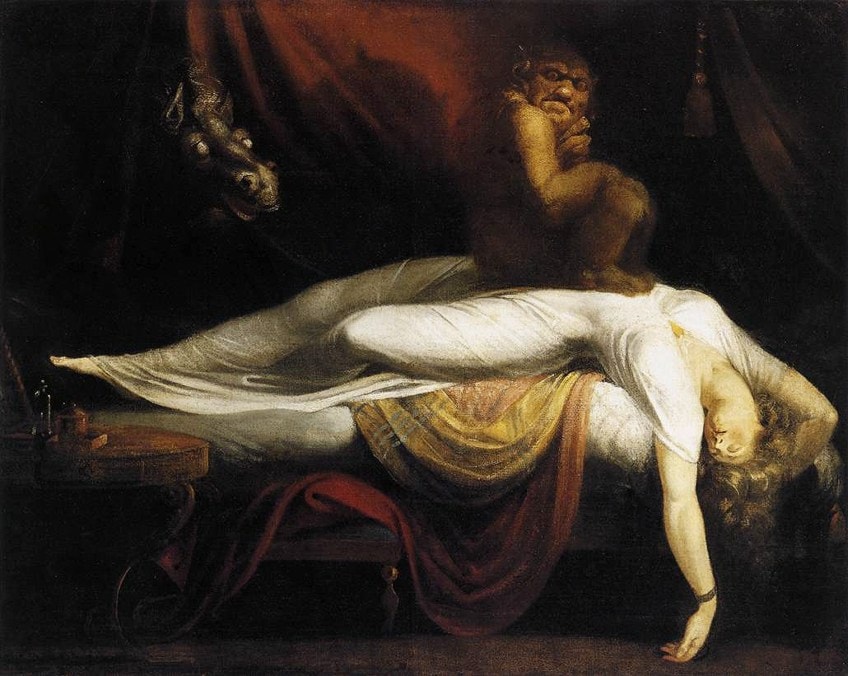 The Nightmare (1781) by Henry Fuseli; Henry Fuseli, Public domain, via Wikimedia Commons
Although the woman is enveloped in bright calorie-free, Fuseli suggests that the low-cal cannot pierce the nightmarish realm of the human mind. The relationship between the woman, the incubus, and the mare is not explicit and therefore remains suggestive, emphasizing the frightening possibilities.
The Nightmare frightened and shocked its audition when exhibited at London's Royal Academy. It was unlike annihilation the public was used to seeing, as the bailiwick affair was not taken from the bible or a moment in history, nor was it created for the sake of moralizing the viewer.
Fuseli'due south painting had a broad-reaching influence and changed the art world, besides as inspiring writers such as Edgar Allan Poe and Mary Shelly with his combination of sexuality, horror, and decease interim as crucial elements for the Gothic horror genre.
Upper Autumn of the Reichenbach: Rainbow (1810) by J. Thou. Westward. Turner
| Artist | J. M. W. Turner |
| Date Painted | 1810 |
| Medium | Watercolor, graphite, and white heightening on paper |
| Dimensions | 27.9 cm x 39.four cm |
| Where It Is Currently Housed | Yale Middle for British Art, Connecticut, the Usa of America |
Joseph Mallord William Turner was ane of the pioneering Western artists to capture ambiance and mood in his Romanticism art pieces. Turner was an exceptionally influential 19th-century landscape painter. He became enraptured past the Reichenbach Falls, a waterfall of the River Aare shut to Meiringen in Switzerland, which he witnessed during his travels in 1802. Upper Fall of the Reichenbach: Rainbow was a scene he painted numerous times both in Switzerland and in his dwelling country of England.
Turner expressed the notion of the "sublime" in his paintings, a concept postulated by the philosopher Edmond Burke, where he depicted the feeling one sensed when experiencing the overwhelming forcefulness and grandeur of nature.
This becomes obvious by the sheer magnitude of the mountains in comparison to the human figure and animals in the bottom left corner of the painting. The minuscule figures indicate the sense of calibration and demonstrate their insignificance while surrounded by the enormity of nature.
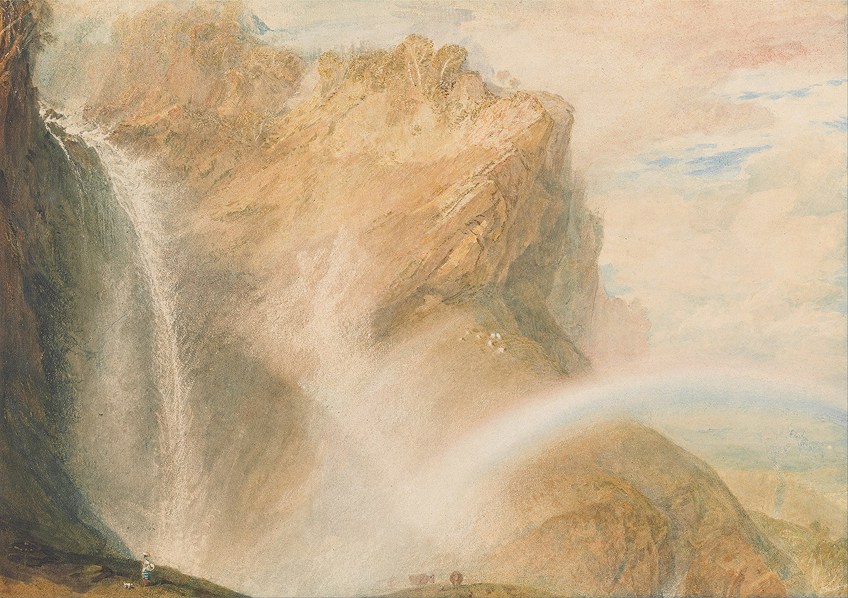 Upper Fall of the Reichenbach: Rainbow (1810) by J. G. Due west. Turner; J. M. W. Turner, Public domain, via Wikimedia Commons
Turner skillfully painted in sparse washes and layers, using a somber color palette, where he rubbed and scraped out the paper's surface with a moisture cloth to convey the dissolving and thunderous spray of the waterfalls against the enormous rocks. During this role of his career, there was more of a focus on tone and form, it was only afterward that color became more meaning for him.
Turner introduced the landscape as an equally significant component of genre art, with paintings of everyday scenes of life– at the time, this was a revolutionary choice. Turner was celebrated as "the painter of light" because of his mastery of depicting luminous colors and atmosphere.
His dynamism and intensity contrasted substantially with the prevalent gimmicky carefully painted topographical scenes.
Third of May 1808 (1814) past Francisco Goya
| Artist | Francisco Goya |
| Date Painted | 1814 |
| Medium | Oil on canvas |
| Dimensions | 268 cm ten 347 cm |
| Where It Is Currently Housed | Museo Nacional Del Prado, Madrid, Kingdom of spain |
Considered one of Spain's well-nigh important artists of the eighteenthursday and 19thursday centuries, Francisco Goya created brilliant and enigmatic artworks that reflected and commented on Espana's contemporary historical turbulence. Goya's groundbreaking famous Romantic art, The Third of May 1808, is arguably his most famous painting. It depicts Napoleonic troops publicly executing Spaniards as retribution for the previous day'south uprising confronting the French.
Goya's brooding palette intensifies the atrocities and creates a feeling of overwhelming darkness.
The Spanish laborer who is about to be executed is represented in a manner that imitates Christ's crucifixion. The figure is kneeling on the ground with his arms flung broad and his correct hand is marked by Stigmata, similar to the marks made on the body of Christ during the crucifixion. The figures' expressive faces and body language convey the cruelty and the turmoil. A lantern on the ground is the only source of light, which divides the scene into the light, highlighting the victims, and shadows, consuming the faceless executioners.
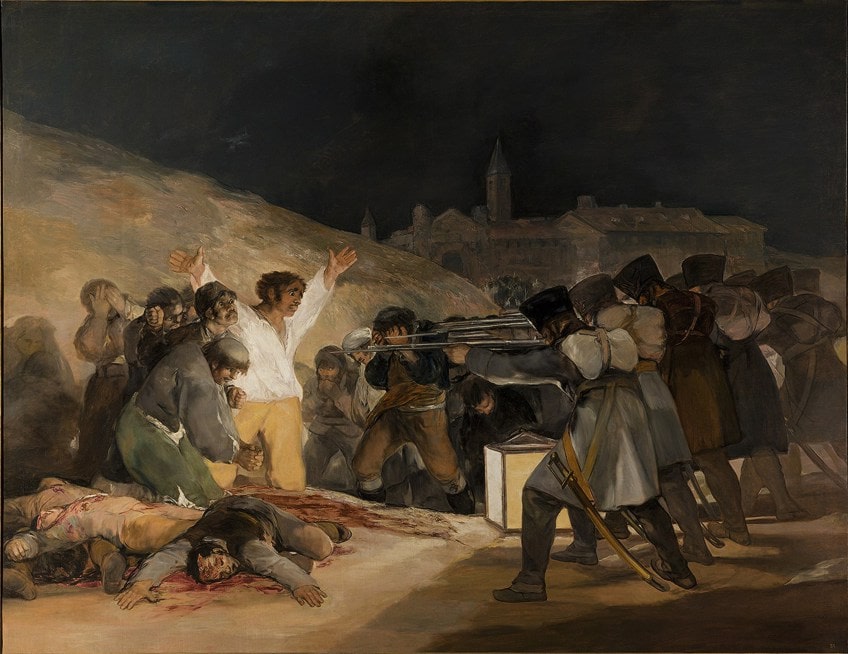 3rd of May 1808 (1814) by Francisco Goya; Francisco de Goya, Public domain, via Wikimedia Commons
Goya created famous Romanticism paintings that bankrupt decisively from the past. The painting was revolutionary, with its unheroic presentation, its granular and matte pigments, and the flatness of its perspective.
Together with Goya's portrayal of a contemporary occasion that was experienced past ordinary people, this defied bookish norms that preferred timeless Neoclassical scenes.
Goya aimed to witness and commemorate the Castilian opposition to Napoleon'due south regular army. He influenced generations of artists that followed him. Goya's revolutionary painting, The Third of May 1808, played a pivotal role in the rise of Realism and its honest depictions of everyday life, in influencing Picasso's representations of the horrors of war, and in encouraging Surrealism'due south examination of dream-like content.
Wanderer above the Sea of Fog (c. 1818) past Caspar David Friedrich
| Creative person | Caspar David Friedrich |
| Date Painted | c. 1818 |
| Medium | Oil on canvas |
| Dimensions | 95 cm x 75 cm |
| Where Information technology Is Currently Housed | Hamburger Kunsthalle, Hamburg, Deutschland |
The German Romantic period creative person Caspar David Friedrich painted ane of the most iconic Romantic-era artworks, Wanderer to a higher place the Sea of Fog, in 1818. Friedrich's artwork depicts an explorer, a young man, from behind perched on a rugged outcrop as he looks beyond to a dumbo sea of fog. Wanderer above the Sea of Fog does non tell a story; it is Friedrich'southward portrayal of an emotional country, 1 that depicts ideas of roaming and infinity, of the imperfection of emotions and the soul.
Friedrich'southward masterpiece presented human against an eerie and mysterious backdrop, demonstrating his diminished power in the vast magnitude of life.
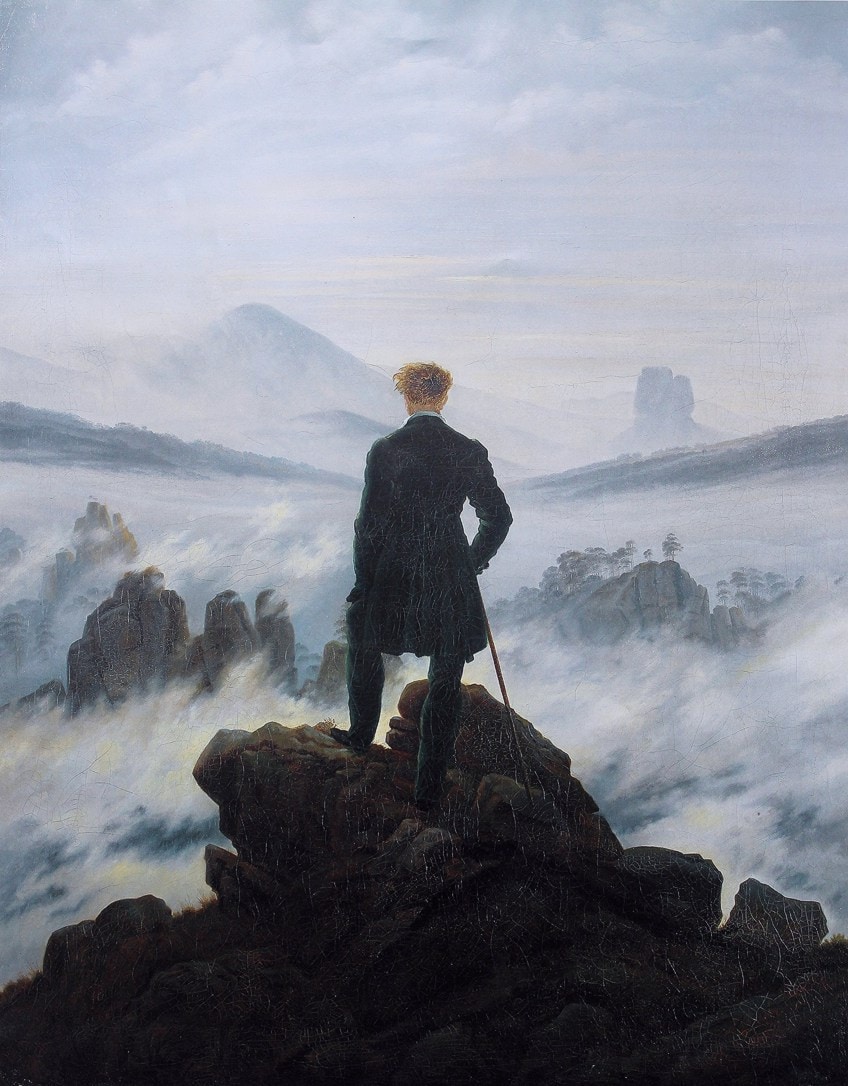 Wanderer above the Sea of Fog (c. 1818) by Caspar David Friedrich; Caspar David Friedrich, Public domain, via Wikimedia Commons
Friedrich skillfully used space to illustrate man'south minuscule standing in nature, a solitary figure amidst the immense landscape. The landscape is made up of composites of landmarks effectually Eastern Germany from the Elbe Sandstone Mountains. The wanderer seems to be contemplating the world that exists before him.
The human's effigy takes upwards a central position in the painting, which may propose that he has command over the world earlier him. Yet, as the fog subtly blends into the horizon, we become aware of the scale of the landscape that stretches infinitely before him. We see that the globe fundamentally remains unknown. Friedrich'due south awe-inspiring painting elevated the mural painting.
This Romanticism artwork is representative of German Romanticism, which had developed slightly differently from its Italian and French counterparts.
The Raft of the Medusa (1818 – 1819) by Théodore Géricault
| Artist | Théodore Géricault |
| Date Painted | 1818 – 1819 |
| Medium | Oil on canvas |
| Dimensions | 490 cm ten 716 cm |
| Where Information technology Is Currently Housed | Musée du Louvre, Paris, French republic |
Théodore Géricault's famous Romantic art, The Raft of Medusa, depicted the shipwreck that took place in 1816 when hundreds of soldiers from the French Royal Navy were dispatched to colonize Senegal. The ship began to sink later on hitting a sandbank and those who survived built an emergency raft to get to shore simply were apace lost at body of water.
Géricault spent months researching the event, speaking to and sketching survivors, studying cadavers, and called on friends to model, including the famous Eugène Delacroix.
The emotional significance of Géricault'southward masterpiece is imprinted on the viewer. Géricault fused reality and art to deliberately portray an artistically and politically confrontational piece. Géricault's decision to depict a Black man at the apex of the composition was incredibly controversial as it expressed his abolitionist sentiments.
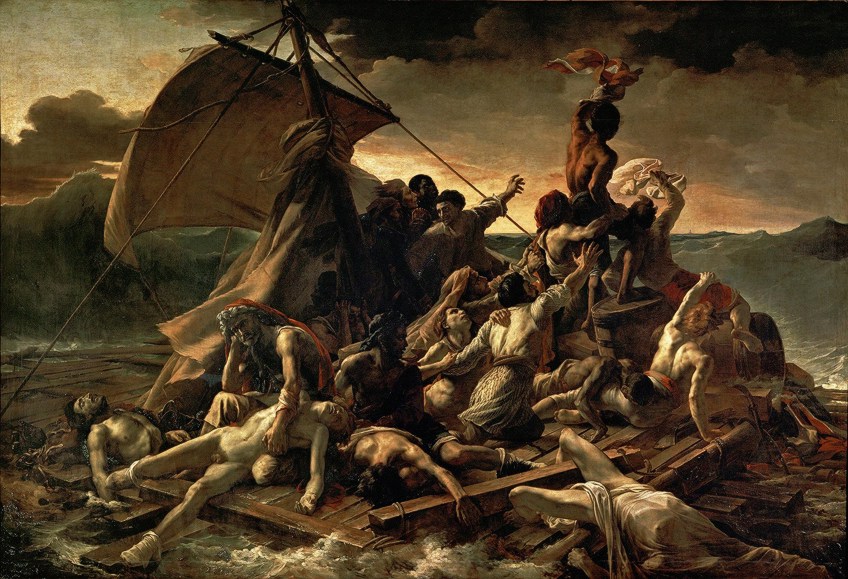 The Raft of the Medusa (1818-1819) by Théodore Géricault; Théodore Géricault, Public domain, via Wikimedia Commons
An intense spectacle is created by his use of low-cal and shadow, along with its diagonal formation that divides the frame with the contorted bodies in the lower-left corner, leading the viewer'southward eyes forth the horrific scene to the elevation effigy waving a cloth, issuing a sign of hope. Forth the diagonal from the sail to the bottom right corner, we meet a body partly shrouded, slipping into the sea.
This composition, together with the majestic and tempestuous heaven is illustrative of Romanticism art pieces and their portrayals of the sublime.
Géricault's painting generated substantial controversy and scandal when it was commencement exhibited in Paris. For the nearly part, the painting moved the viewing public, however many were repelled by Géricault's option of subject matter. It faced criticisms regarding its departure from Classicism as it disregarded the portrayal of "platonic beauty", with its representation of Realism. When Géricault exhibited his piece of work in London information technology had a considerably more than positive reception, and it gained acclaim for introducing a new direction for French art.
The Hay Wain (1821) by John Constable
| Artist | John Lawman |
| Date Painted | 1821 |
| Medium | Oil on canvas |
| Dimensions | 130.2 cm x 185.4 cm |
| Where Information technology Is Currently Housed | National Gallery, London, United kingdom |
John Constable was an English Romantic catamenia creative person dedicated to pastoral landscape artworks. The Hay Wain is arguably his greatest piece of work and his unique power to bring natural landscapes to life earned him great acclaim. The Hay Wain depicts a unproblematic scene of English farmers tending to their piece of work in this majestic painting. Information technology demonstrates Constable's brilliance, every bit he can capture in a painting how fleeting atmosphere dictates how we view landscapes.
In this painting, human being does not simply find nature from afar; Lawman portrays him as an intricate role of nature, merely equally the birds and the trees are– not separate from information technology.
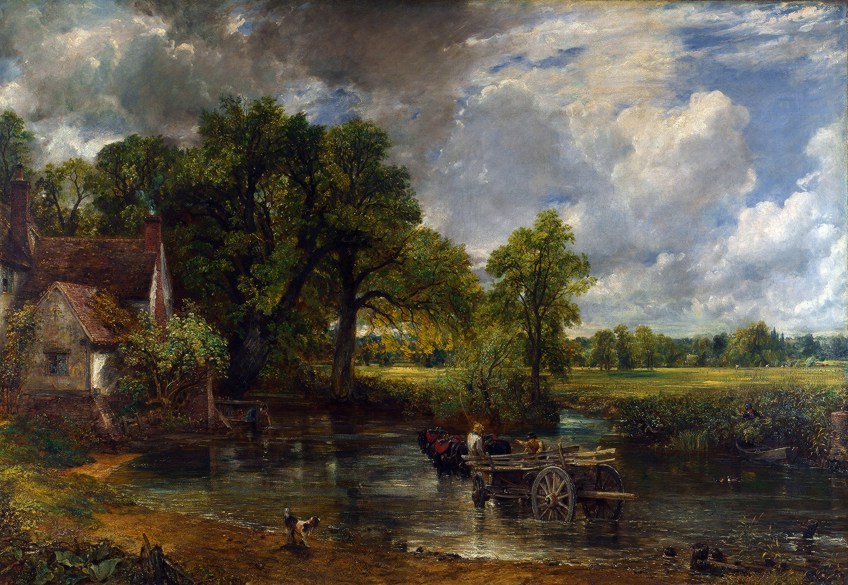 The Hay Wain (1821) past John Lawman; John Lawman, Public domain, via Wikimedia Commons
The figures are fatigued to calibration with the environment, suggesting Constable's efforts to express the oneness with nature in his painting. The Hay Wain has been recognized as one of the well-nigh infrequent Romantic-era artworks depicting a landscape, too as existence ane of the most revered works past an English artist.
When outset exhibited, Constable'south masterpiece was considered provocative and impertinent, as the large painting seemingly used the aforementioned techniques, utilizing modest brushstrokes, like the Impressionists.
According to London's oversupply, this was scandalous, whereas the French adored this manner of painting, employed past artists such as Géricault. When The Hay Wain was exhibited in Paris it caused quite the sensation. Information technology earned Constable a gilt medal from King Charles X of France, for the impact of his artwork at the Paris Salon.
Épisode des Journées de Septembre 1830 (1830) past Marie-Adélaïde Kindt
| Artist | Marie-Adélaïde Kindt |
| Date Painted | 1830 |
| Medium | Oil on canvas |
| Dimensions | Unknown |
| Where Information technology Is Currently Housed | City Hall of Brussels, Belgium |
Unfortunately, very little is known about the creative contributions of women during the Romanticism movement. This seems to be a consistent theme throughout art history– often ignored and rarely understood, women who accept defended themselves to the visual arts have had to persevere.
One such adult female is Marie-Adélaïde Kindt, a Belgian painter who was a leading artist during the 1820s and 1840s. Kindt was 1 among a few female artists that came from her family.
Antoine Cardon, an engraver, trained Kindt in the art of drawing. She and then received Neoclassical training when studying painting under François-Joseph Navez, but the work she produced took on the influence of Romanticism.
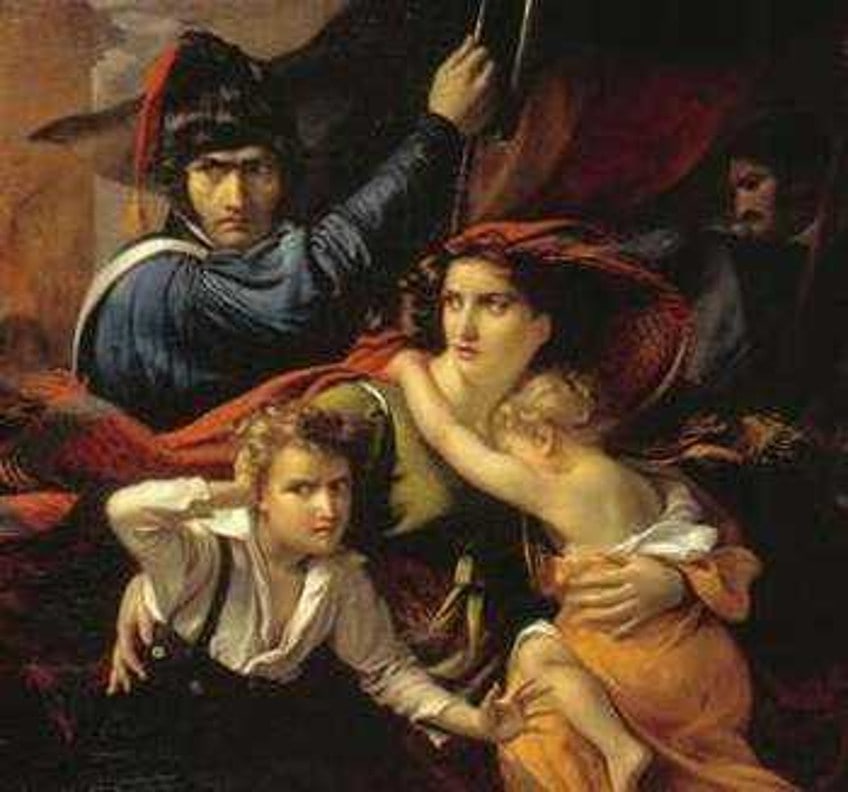 Épisode des Journées de Septembre 1830 (1830) by Marie-Adélaïde Kindt; Adèle Kindt, Public domain, via Wikimedia Commons
Kindt'due south work comprised of many historic scenes, with her nearly influential piece being Épisode des Journées de Septembre 1830, which was a portrayal of the Belgian Revolution that took place the same year. Her masterpiece now sits in the City Museum in Brussels.
Kindt'due south creative contributions were encouraged past notable artists such equally Jacques-Louis David. She connected to paint throughout her life, but her later work was less aggressive as she took on more Romanticism portraits and genre paintings, adjusting her mode to cater to the taste of the public.
Kindt was not able to revive the success of her earlier career, merely her legacy lives on with the pieces of art she left behind.
Liberty Leading the People (1830) by Eugène Delacroix
| Creative person | Eugène Delacroix |
| Date Painted | 1830 |
| Medium | Oil on canvass |
| Dimensions | 260 cm x 325 cm |
| Where It Is Currently Housed | Musée du Louvre, Paris, France |
Eugène Delacroix is considered the most representative French Romanticism painter. Delacroix's masterpiece, Freedom Leading the People, commemorates a scene from the July Revolution in 1830 where the abdicated King Charles X was overthrown. The painting was completed the same twelvemonth upshot occurred. Not to be dislocated equally a depiction of the 1789 French Revolution. Delacroix's triumph represents freedom, revolution, and the people'southward victory.
This captivating piece is one of the near well-known Romantic-era artworks.
Delacroix's painted an apologue of the revolution rather than depicting an actual scene. Lady Liberty is depicted leading the unified group of people confronting the oppressor as an human action of patriotism. Social class was non of import, as can exist seen by the mixture of people– the message was unity. Although the bare-chested effigy is reminiscent of the Greek Classical ideal, with her clothes draped over her frame, Delacroix depicts her with pilus on her underarm to advise that she is in fact real and not simply an ideal.
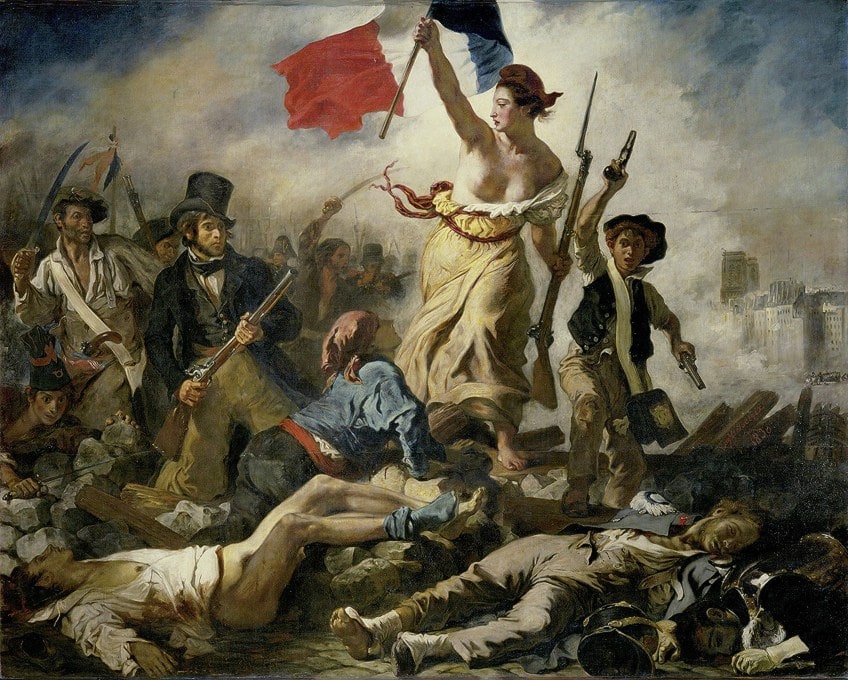 Liberty Leading the People (1830) by Eugène Delacroix; Eugène Delacroix, Public domain, via Wikimedia Eatables
Liberty is depicted wearing a Phrygian cap, symbolic of freedom and the pursuit of freedom, holding a bayonet, and raising the tricolor flag equally she encourages the rebellious grouping onwards on their course to victory. Every detail in Delacroix'south painting holds political significance and merges it with trigger-happy emotions.
The turbulent scene highlights expiry, suffering, and heroism, which are archetypal themes of famous Romantic art.
Liberty Leading the People was a distinguished Romanticism artwork with a legacy that inspired notable works such every bit Liberty Enlightening the World (1886), more unremarkably known as the Statue of Liberty by Frédéric Auguste Bartholdi. Delacroix'south painting has been credited for inspiring the 1862 novel Les Misérables by Victor Hugo. To this twenty-four hours Freedom Leading the People continues to hold its weight, being featured on the 2008 album encompass for Coldplay's Viva la Vida.
Thomas Cole's Romanticism artwork, The Titan's Goblet, serves as the peak of his Romantic fantasies. The Titan's Goblet mimics Cole's other famous Romanticism paintings, with its depiction of an Italian landscape and its illustration of themes relating to the grandeur of time past and nature's significance and ability for encroachment. The Titan's Goblet is arguably Cole's most enigmatic painting of his allegorical landscape works. The Metropolitan Museum of Fine art has expressed that this magnificent painting "defies total explanation". Cole's painting is considered a "picture within a picture", as ii landscapes exist within the painting. The foot of the goblet stands on traditional terrain, yet a whole other world exists along its rim. Lush vegetation runs forth the rim, with ii tiny buildings breaking the greenery, ane is an Italian palace and the other a Greek temple. A vast body of h2o fills the goblet to the skirt, and it is dotted with sailing boats. H2o spills over onto the ground below marked by some other civilization. The Classical ruins which are found on the Goblet's rim and the sailing boats that wade through the water have been linked to Greek and Norse mythology. As they sit down far removed from the civilisation beneath, it has been interpreted as a disassociation from the present. Some other theory relates the self-contained civilization to a microcosm of the homo world amidst the commanding body of nature. The stalk of the goblet and then unites the by and the present. The Titan's Goblet is recognized equally a unique piece of artwork. Ivan Aivazovsky was a Russian-Armenian Romantic menstruation artist who specialized in marine fine art. His triumph The Ninth Wave is recognized every bit i of the most exceptional seascapes of Romanticism art. The painting depicts massive waves sweeping beyond a volatile ocean. The wreckage floats in the painting's foreground. This painting gets its championship and theme from an quondam crewman's tale, a traditional belief that was held for centuries preceding the 1800s, where the ninth wave was said to be the most enormous and destructive. The figures cling to the debris from the ship, in the face of death they attempt to salvage themselves. It is suggested that the wreckage forms the shape of a cross, indicating a religious undertone in Aivazovsky'southward work. This piece of work serves as an apologue, according to Christianity, for salvation from sin. The palette of the painting utilizes warm tones, diminishing the ferocity of the sea and conveying a sense of hope and a adventure for survival. Aivazovsky masterfully demonstrates the beauty and destruction of nature. Aivazovsky'southward talents gained him international acclamation, leading him to be one of the few Russian painters to achieve such success during his lifetime. To this day, he remains one of the near distinguished marine artists, speaking to the impact of his artistic feats. Anton Chekhov, a famous Russian writer, once described something as "worthy of Aivazovsky's brush", which and then became the standard phrase referenced when describing anything that was overwhelmingly beautiful. Francesco Hayez was a famous Italian Romantic period artist and his painting, The Osculation, is considered his all-time-known work. Alfonso Maria Visconti di Saliceto deputed the painting, later donating information technology to the Pinacoteca di Brera. The Kiss depicts a man and a adult female embracing in a passionate osculation, enveloped into ane another, their faces remain subconscious. The figures represent a couple from the Middle Ages as suggested by their dress. However, they remain unrecognizable, as Hayez wanted the focus to remain on the act of their embrace. The Kiss showcases Hayez'south incredible skill as he executed his painting with such fine detail. Hayez fused scenes of infrequent beauty with political accounts. The underlying message Hayez imparts on the viewer is that of a national union as the painting was representative of Risorgimento, the "Italian Unification". Hayez aimed to pay homage to the French considering they were allied to Italy, hence the painting's chromatic range with the crimson of the man's tights, and the white and blue of the woman's dress, alluding to the French flag. This painting is a symbolic masterpiece that has come to represent Italian Romanticism. Hayez is regarded equally Italia's most famous Romantic-era creative person, with creative contributions that stretch from magnificent Romanticism portraits to monumental historical paintings. His influence had an instrumental touch on the generations of artists that followed in Italian republic. The Kiss relished in its popularity from the first fourth dimension it was exhibited and onwards. Luchino Visconti, an Italian director, took inspiration from The Kiss for a scene in his 1954 production, Senso. Susie G. Barstow was a member of the Hudson River School, which was a mid-19th-century American fine art movement that was incorporated by a class of landscape painters whose visual compositions were heavily influenced past Romanticism. The Hudson River Valley was regularly depicted by the artists as well equally its surrounding areas, which included the Catskill Mountains. Barstow was known for her luminous landscapes, such every bit her imperial Kaaterskill Creek painting. Barstow's landscapes were infused with calorie-free, emanating serenity and the beauty of nature. Her piece of work was exhibited at the National Academy of Design, the Pennsylvania Academy of the Fine Arts, and the Brooklyn Fine art Association, to name a few. During her fourth dimension women did not take the same opportunities to have their works exhibited, which led to a number of her works going unnoticed until fine art historians revisited the contributions of women artists from the Hudson River Schoolhouse. The title of an amateur artist was as accessible to women and men, however any championship indicating that of a professional artist was generally reserved for men and far less available for women. Making annotation of incredible artists such as Barstow, we should be careful not to take the records of her work for granted. The lack of information attainable regarding women artists will have us believe that Barstow was the exception, rather than simply recognizing that her piece of work was exceptional, much similar the work of her female contemporaries. Particularly those, who because of their gender were faced with many barriers that suppressed their accomplishments from getting the due they deserved. These famous Romanticism paintings that we selected for our list are truly magnificent examples of the imaginative and spirited artworks that artists contributed to the movement. Their influence holds to this day, as they shaped movements that followed and generations of artists that succeeded them. If you are curious to learn more about art history, browse through our website, where you lot are sure to find more manufactures to pique your interest! The Romanticism movement dominated Europe in the late 18th century. Information technology was an creative, intellectual, and literary movement cultivated as a reaction to the Classicism and Neoclassicism movements that preceded it. A distinct break from the trends of intellectual idea, industrialization, rationalization, and glorification of science. The Romanticism movement was emotionally charged and sought to entertain the imagination, we encounter that in the fantastical and inspired paintings that emerged from this period. Romanticism indulged the artist's emotions and imagination, allowing these feelings and ideas to permeate the viewer. Romantic-era paintings highlighted the individual, the personal, the subjective, the imaginative, the emotional, the transcendental, the visionary, and the sublime. In Romanticism portraits and Romanticism art pieces, artists portrayed scenes of honey, beauty, suspense, horror, acrimony, and adoration that were aimed to provide an escape from reality. Romantic-era paintings paid homage to the power of nature, honoring its unpredictability and beauty. Nature'south potential for disaster was prominently shown in fine art, along with the portrayal of commanding, poignant feelings that induced empathy. Romantics glorified emotion and intuition over logic and intellect. Romanticism art was attuned to cute scenes of nature or the sublime, incorporating the way humans feel in nature. Danger and dazzler divers nature's sublime artful. Romanticism portraits and Romanticism art pieces exhibited bright colors and energetic brushstrokes. Famous Romantic art favored dynamic compositions over static ones. Romantic-era paintings were used to express individuality and instinct instead of depicting arcadian representations of the Classical past. The Titan'south Goblet (1833) by Thomas Cole
Artist Thomas Cole Appointment Painted 1833 Medium Oil on canvas Dimensions 49.ii cm x 41 cm Where It Is Currently Housed Metropolitan Museum of Fine art, New York, the U.s. of America
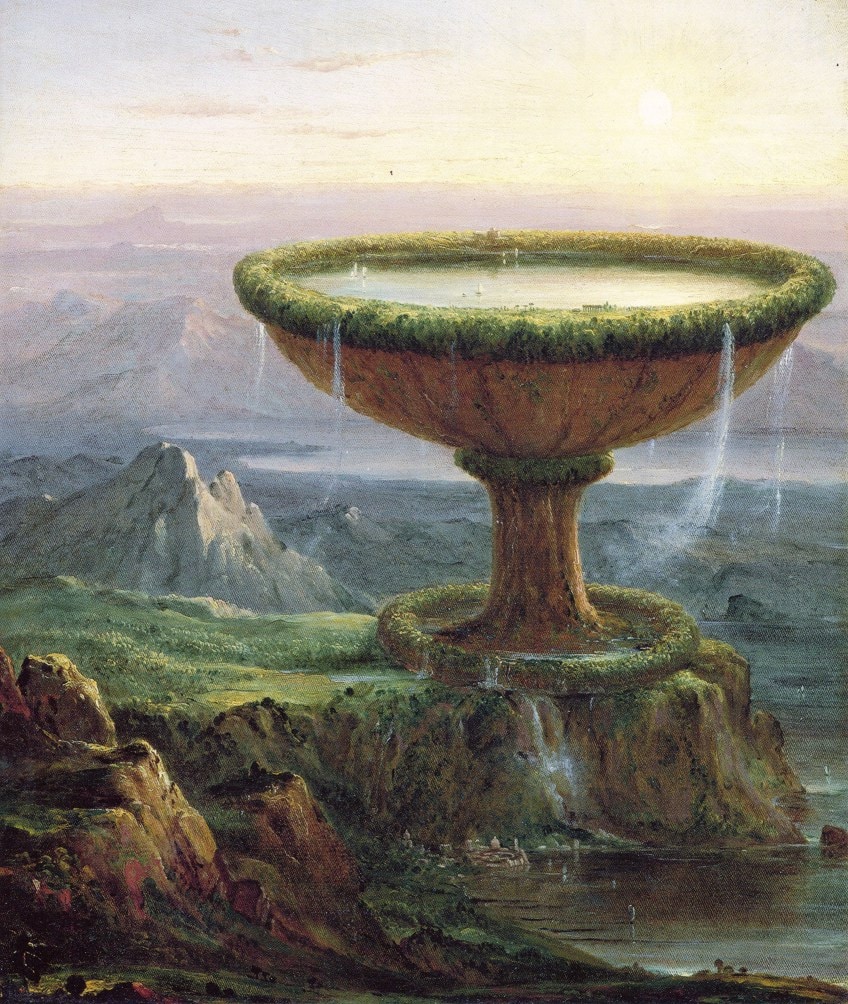 The Titan's Goblet (1833) by Thomas Cole; Thomas Cole, Public domain, via Wikimedia Eatables
The Ninth Wave (1850) past Ivan Aivazovsky
Creative person Ivan Aivazovsky Date Painted 1850 Medium Oil on canvass Dimensions 221 cm x 332 cm Where It Is Currently Housed The State Russian Museum, Mikhailovsky Palace, Russian federation
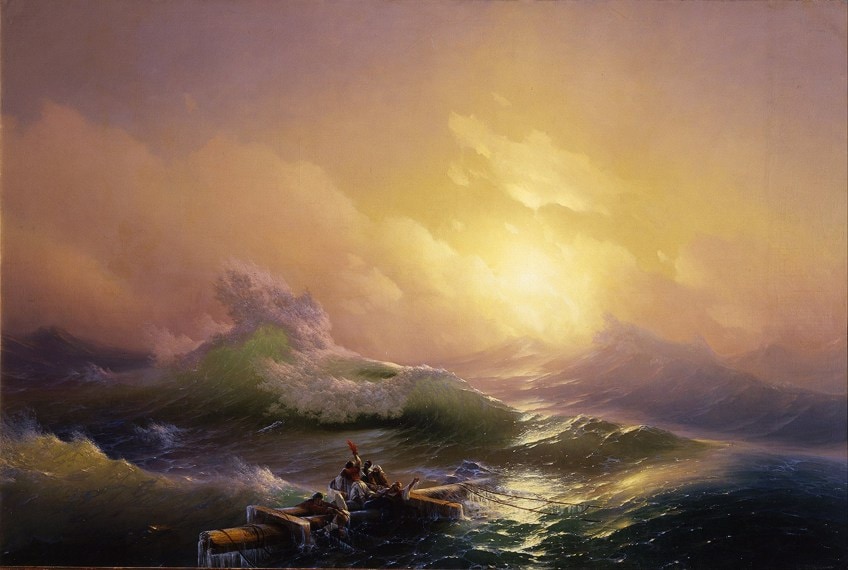 The Ninth Moving ridge (1850) by Ivan Aivazovsky; Russian Museum, Public domain, via Wikimedia Commons
The Kiss (1859) past Francesco Hayez
Creative person Francesco Hayez Date Painted 1859 Medium Oil on canvas Dimensions 110 cm x 88 cm Where Information technology Is Currently Housed Pinacoteca di Brera, Milan, Italy
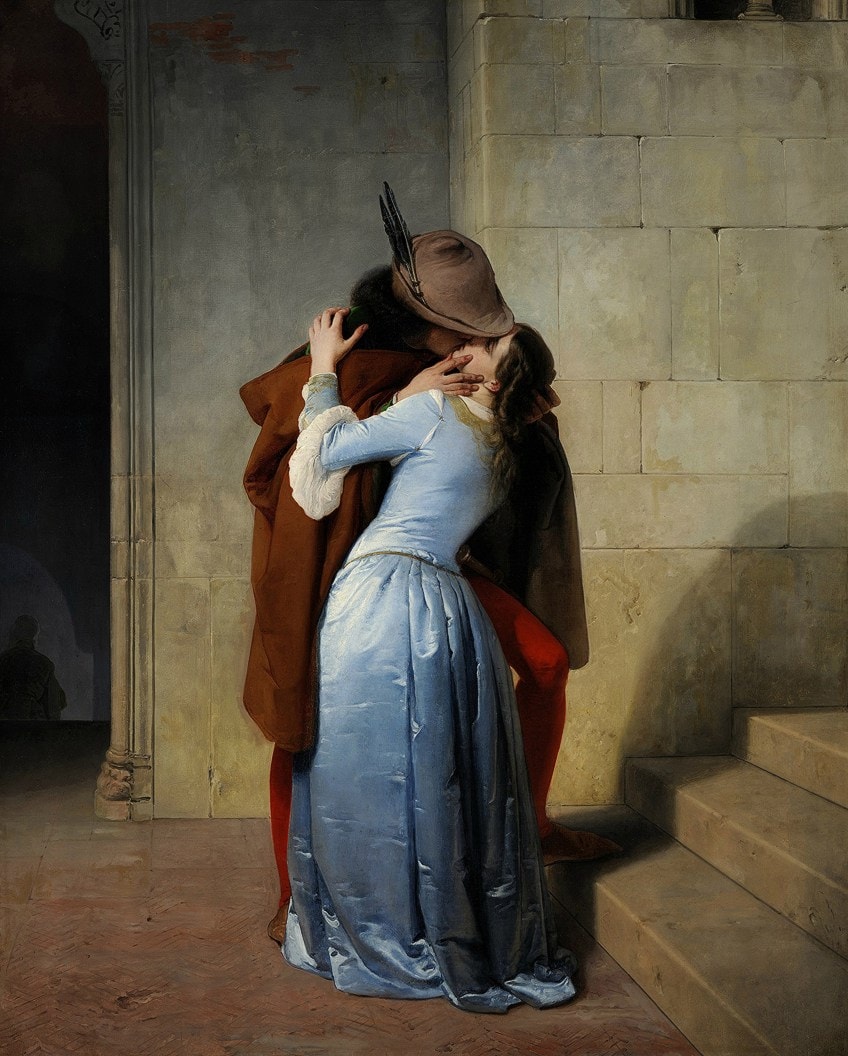 The Osculation (1859) by Francesco Hayez; Francesco Hayez, Public domain, via Wikimedia Commons
Kaaterskill Creek (c. 1870) by Susie 1000. Barstow
Creative person Susie Thousand. Barstow Date Painted c. 1870 Medium Oil on canvass Dimensions Unknown Where Information technology Is Currently Housed Individual Collection
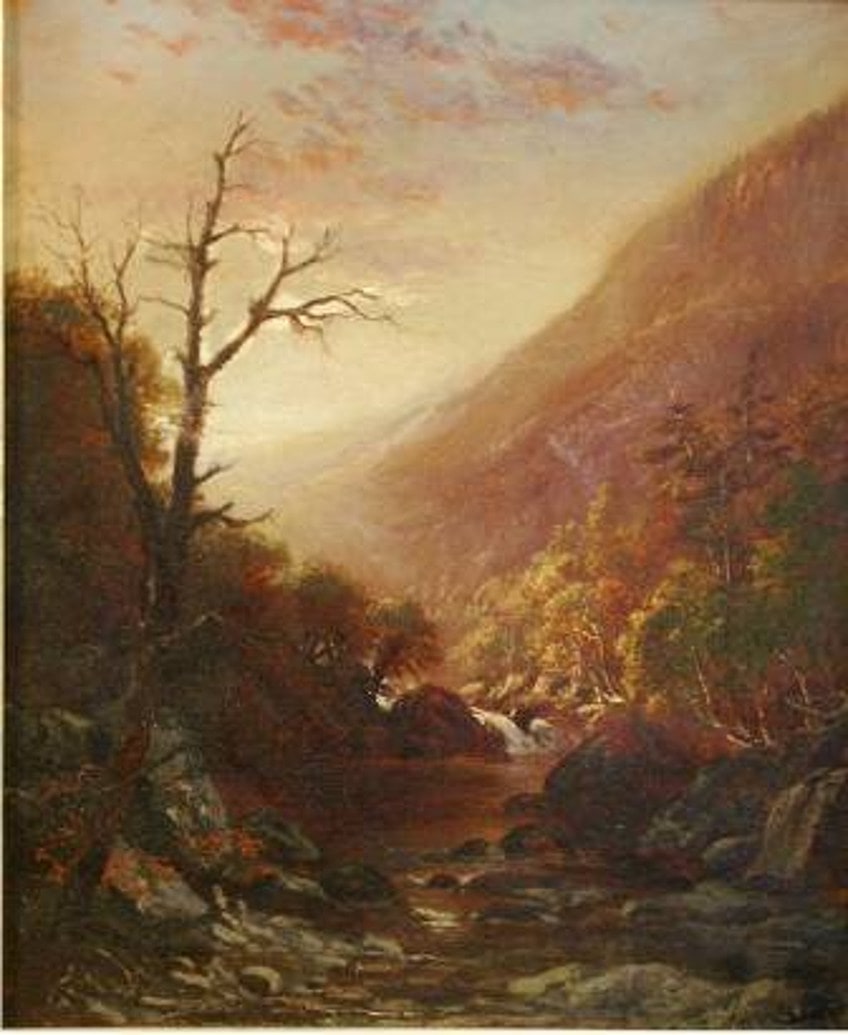 Kaaterskill Creek (c. 1870) past Susie Yard. Barstow; Susie M. Barstow, Public domain, via Wikimedia Commons
Frequently Asked Questions
What Is Romanticism?
What Are the Characteristics of Romanticism Art?
How Is Romanticism Shown in Fine art?
Source: https://artincontext.org/famous-romanticism-paintings/
0 Response to "Famous Art Pictures Famous Art Pictures That Looks Like Imagenation"
Post a Comment